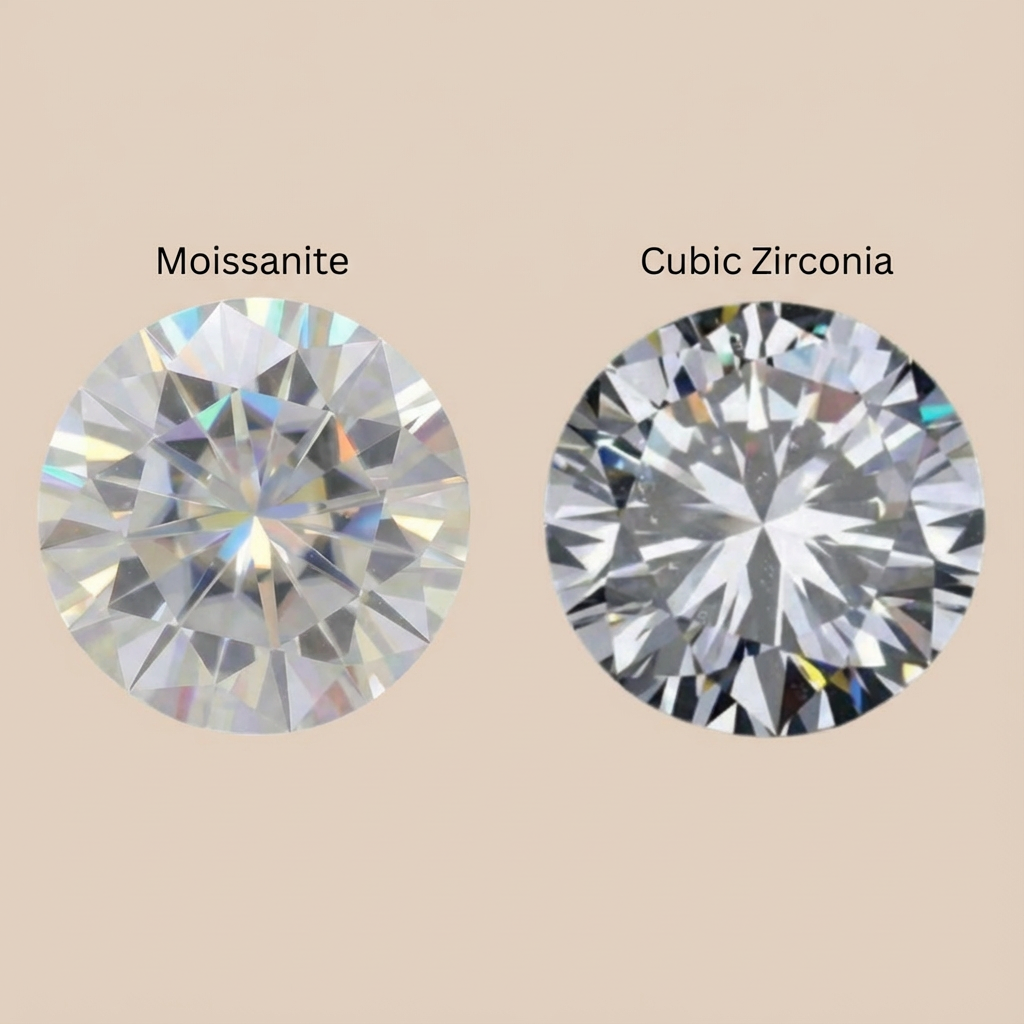
If you are in the market for diamond alternatives, you have likely come across two heavy hitters: Moissanite and Cubic Zirconia (CZ).At a glance, they both look nearly identical to a diamond. They are both affordable, ethical, and dazzling. But if you dig a little deeper, you’ll find that these two stones are actually quite different.Let’s dive into the ultimate comparison: Moissanite vs. Cubic Zirconia.
The Tale of the Tape: What Are They?
Before we judge them, we need to know what they are made of.
What is Cubic Zirconia (CZ)?
Cubic Zirconia is a synthetic gemstone made of zirconium dioxide. It was first discovered in 1937 but wasn’t successfully synthesized for jewelry use until the 1970s. It was created specifically to mimic the look of a diamond. Because it is grown in a lab, it is classified as a synthetic gemstone.
What is Moissanite?
Moissanite is a naturally occurring mineral (silicon carbide) that was discovered in 1893 by French chemist Henri Moissan. However, natural moissanite is incredibly rare—rarer than diamonds—so it is almost never found in jewelry. Today, nearly all moissanite on the market is lab-created. Unlike CZ, which was invented to be a diamond simulant, moissanite is considered a unique gemstone in its own right.
The 4 Key Differences
To determine which is “better,” we need to look at the four categories that matter most in jewelry: durability, brilliance, price, and ethics.
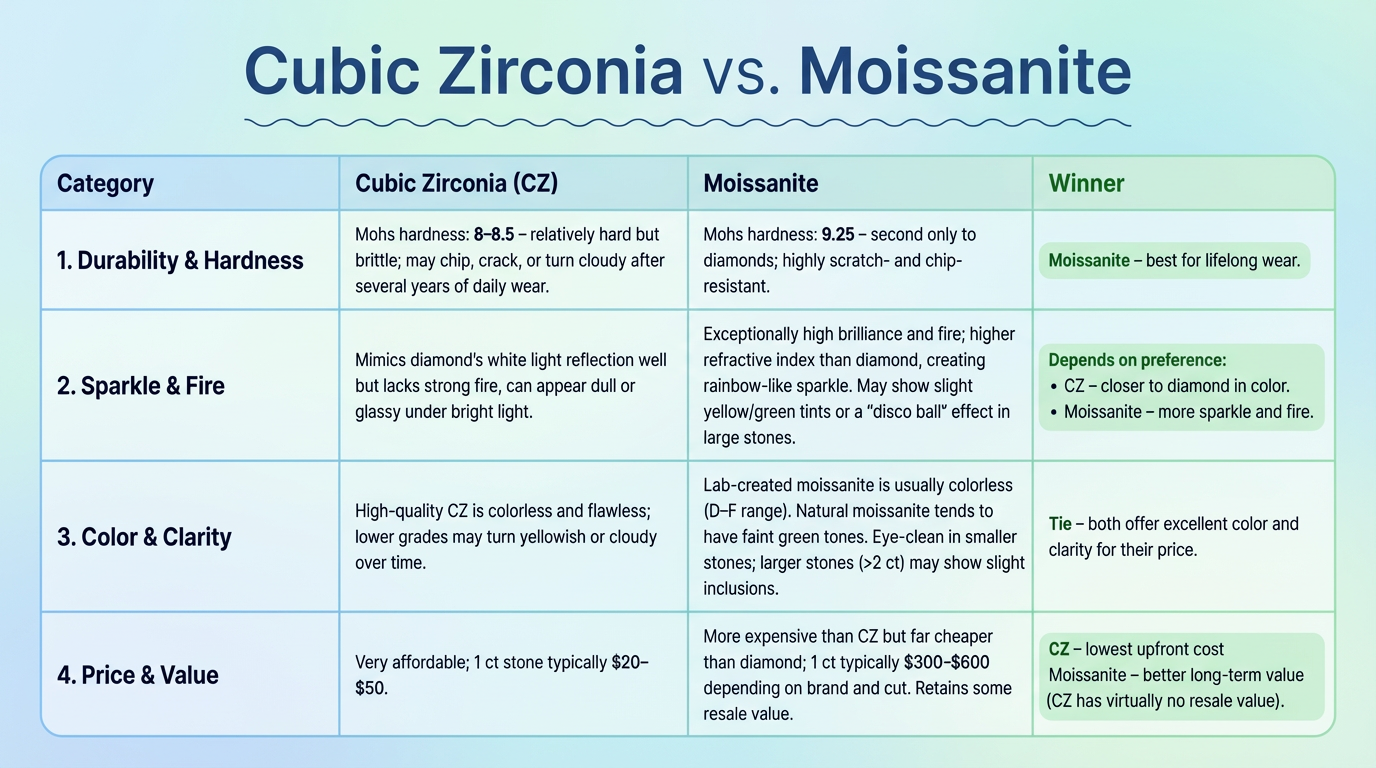
1. Durability and Hardness
If you are buying an engagement ring or a daily-wear piece, durability is non-negotiable.
- Cubic Zirconia: On the Mohs scale of hardness (where 10 is the hardest), CZ ranks at an 8 to 8.5. While that sounds hard, CZ is somewhat brittle. Over time (usually within a few years of daily wear), CZ stones can chip, crack, or become cloudy.
- Moissanite: Moissanite ranks at 9.25 on the Mohs scale. This makes it the second hardest gemstone used in jewelry, right after diamonds. It is highly resistant to scratching and chipping.
The Winner: Moissanite. If you want a stone that will last a lifetime (and beyond), Moissanite is the clear choice.
2. Sparkle and Fire (The “Bluish” Tint)
Both stones are famous for their sparkle, but they handle light differently than a diamond.
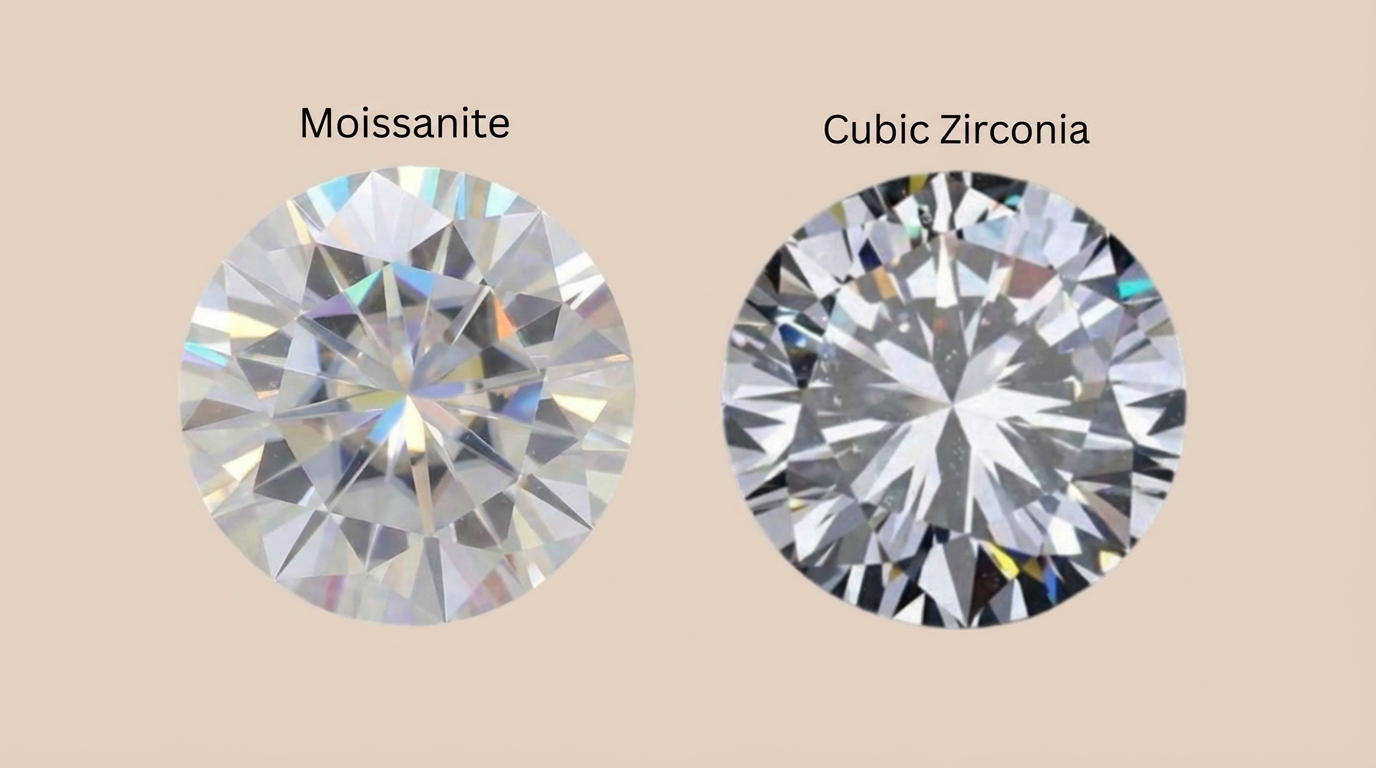
- Cubic Zirconia: CZ mimics a diamond’s white light reflection quite well, but it lacks the complex “fire” of a diamond. Under bright sunlight, high-quality CZ can sometimes appear slightly dull or glassy.
- Moissanite: Moissanite is known for its extreme brilliance. It has a higher refractive index than a diamond (and CZ), meaning it returns more light to your eye. This creates a dazzling, rainbow-like sparkle. However, because of this high dispersion, moissanite can sometimes show a yellow or greenish hue in certain lighting, or a “disco ball” effect in very large stones.
The Winner: It depends on preference. If you want a stone that looks exactly like a diamond, CZ is a closer color match. If you want maximum sparkle and fire, Moissanite wins.
3. Color and Clarity
- Cubic Zirconia: Top-quality CZ is colorless and flawless. However, lower-quality CZ can turn yellowish or cloudy over time due to exposure to oils and chemicals.
- Moissanite: Most lab-created moissanite is colorless (graded D-E-F). However, natural moissanite is usually faintly green. While high-quality moissanite is eye-clean, very large stones (over 2 carats) might show slight inclusions if not purchased from a premium brand.
The Winner: Tie. Both stones offer excellent clarity and color at accessible price points.
4. Price and Value
This is where most shoppers make their decision.
- Cubic Zirconia: CZ is incredibly affordable. You can often buy a CZ stone for a fraction of the cost of a moissanite. A 1-carat CZ ring might cost $20 to $50.
- Moissanite: While significantly cheaper than a diamond, moissanite is more expensive than CZ. A 1-carat moissanite stone typically ranges from $300 to $600, depending on the brand and cut.
The Winner: Cubic Zirconia for the lowest upfront cost. However, Moissanite holds some value, whereas CZ has virtually zero resale value.
The Pros and Cons Cheat Sheet
Still undecided? Here is the quick breakdown.
Moissanite
Moissanite stands out for its strength and longevity, with a hardness of about 9.25 that makes it ideal for daily wear. Its brilliance and fire are striking, often producing more sparkle than a diamond, and it’s also an eco-friendly, conflict-free choice. While it resembles a diamond in appearance, it remains a distinct gemstone with its own character and can retain some resale value.
On the downside, moissanite is more expensive than cubic zirconia. Its signature rainbow-like sparkle can also feel a bit too intense for those who want a look that closely mimics a natural diamond.
Cubic Zirconia
Cubic zirconia is widely appreciated for its low cost, making it a go-to option for fashion jewelry or short-term wear. When new, it can closely resemble a diamond in terms of color and clarity, and it’s easy to find in a wide range of styles.
However, it lacks long-term durability and is prone to scratching, chipping, and becoming cloudy over time. It has no resale value and may discolor when exposed to heat or certain chemicals.
The Verdict: Which is Better?
The answer depends entirely on your intention for the jewelry.
Choose Cubic Zirconia if:
- You are on a strict budget. If you only have $50 to spend, CZ is your best friend.
- It’s for a temporary or trendy piece. If you want a cocktail ring for a specific event or a fashion piece you won’t wear daily, CZ is perfect.
- You are testing a style. If you aren’t sure if you like a halo or a solitaire setting, buy a CZ version first to test it out before investing in a permanent stone.
Choose Moissanite if:
- You want an heirloom. If you are buying an engagement ring or a piece you intend to wear every day for decades, Moissanite is the superior choice due to its hardness.
- You want the best “bang for your buck.” You get a stone that is nearly as hard as a diamond and more brilliant than a diamond for a fraction of the price.
- You care about ethics. Both are ethical, but moissanite is marketed heavily as a sustainable, eco-conscious choice.
Final Thoughts
When comparing Moissanite vs. Cubic Zirconia, “better” is subjective.
Cubic Zirconia is the ultimate budget-friendly option that looks great for a short time. Moissanite is the diamond alternative that offers longevity, brilliance, and prestige.
If you have the budget to stretch just a little bit further, we highly recommend choosing Moissanite. It bridges the gap between the affordability of synthetics and the durability of diamonds, making it the smartest investment for your jewelry collection.