Wondering about the difference between a pendant and a charm? They can look similar. But they serve different purposes. A pendant usually takes center stage on a necklace. A charm is smaller and more personal. You can add it to a bracelet, necklace, or anklet. Once you know the difference, choosing the right piece gets much easier. It also helps when you’re shopping for yourself or a meaningful gift.
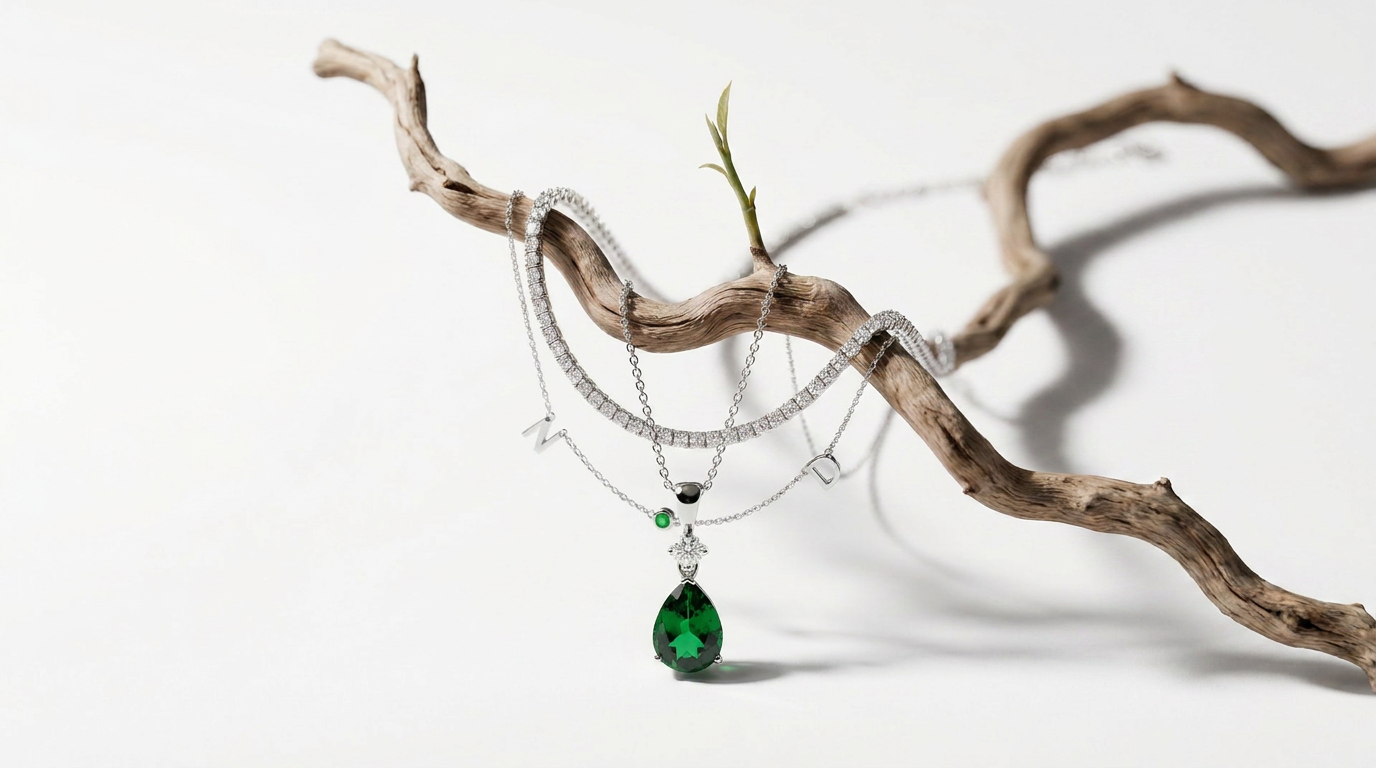
What Is a Pendant?
A pendant is a piece of jewelry that hangs from a chain worn around the neck — and it typically serves as the centerpiece of the whole look. The word comes from the Latin pendere, “to hang,” which is about as literal as etymology gets. Pendants are usually sold as complete necklaces, chain included, because the chain and the piece are generally designed as a pair.
What a pendant looks like is wide open. They come in countless styles and materials, including:
- Precious metals — gold, silver, platinum, often with sculptural or engraved detail
- Gemstones and diamonds — solitaire drops, halos, birthstones, clusters
- Crystals and enamel — color-forward designs that lean playful or vintage
- Keepsake forms — lockets, nameplates, initial discs
Some pendants carry religious or cultural meaning, like crosses, stars of David, or protective amulets. Others are purely ornamental, or hold personal weight like a locket with a photo inside. People have worn pendants for thousands of years, and for most of that history the idea has been the same: one piece, hanging where people can see it.
What Is a Charm?
A charm is a small decorative piece built to attach to something else — most often a bracelet, though charms also appear on anklets, necklaces, bags, and keyrings.
Charms are designed to be collected and combined. Each one typically represents something meaningful to the wearer, which is how a charm bracelet slowly turns into a wearable scrapbook.
The tradition of wearing symbolic charms goes back to ancient civilizations, who wore them as amulets for protection and good fortune. Charm bracelets as a fashion became especially popular in the mid-20th century, and they’ve been cycling back into style ever since.
Common types of charms include:
- Miniature objects — tiny animals, musical instruments, travel souvenirs
- Letters and numbers — initials, important dates
- Symbols of luck or protection — four-leaf clovers, evil eyes, hamsa hands
- Milestone markers — graduations, births, new homes, retirements
Pendant vs. Charm: The Key Differences
Looking at the two side by side, the distinctions are real but subtle — and they occasionally overlap. These are the three dimensions that tend to settle most cases, plus one practical one.
Size and Scale
Pendants tend to be larger, while charms are usually smaller and more delicate, sized to work in groups without overwhelming the wrist or neckline.
That said, the boundary is soft. Some pendants are quite small, and some statement charms run larger than petite pendants. Size alone usually isn’t enough to settle the question — which is where the next two dimensions come in.
Purpose and Display
A pendant is generally designed to be the single focal point of a necklace, drawing the eye to one element. Charms are more often intended as part of a collection, where several pieces work together to tell a story or mark a set of memories.
The simplest version: a pendant tends to say look at this. A charm tends to say remember this.
Attachment Methods
Most pendants attach through a bail — a small loop at the top, often soldered closed or built into the design, which the chain threads through. Once assembled, the piece usually stays put.
Charms more often use a jump ring, spring ring, or lobster clasp that opens, so they can be added, removed, and rearranged whenever the mood strikes.
Of course, It’s a reliable guideline rather than a rule — designers cross these lines all the time.
How They’re Typically Sold
Pendants usually arrive as a finished necklace, chain and clasp included. Charms are typically sold individually or in small sets, with the chain or bracelet separate — which reflects the collecting habit: you add to a charm collection piece by piece, over years.
How to Choose Between a Pendant and a Charm
In reality, both pendants and charms are widely popular, and the choice largely depends on personal preference. That said, the following points may help you make your decision.
A pendant tends to be the better fit when:
- You want one necklace that does everything — a solitaire or medallion on a 17–18 inch chain can read polished under a blazer, relaxed over a t-shirt, and right at dinner
- A gemstone is the point — pendant proportions generally suit a proper stone with real sparkle, which is part of why diamond pendants are such a classic anniversary and milestone gift
- You’re giving a “main event” gift — a pendant arrives complete, chain and box and moment included
A charm tends to be the better fit when:
- You love the idea of building something that grows — a starter bracelet plus one charm per milestone becomes a piece that’s difficult to replicate or replace
- You’re marking something specific — a graduation, a new baby, a first home. A charm for this exact moment often lands with more feeling than a generic statement piece
- You’re adding to someone’s existing jewelry — a birthstone charm joining a chain she already wears every day says “I noticed,” and it’s often the safer call when you’re less sure of someone’s taste
And if you’re truly torn? A pendant is often the safer starting point, simply because it’s complete on its own and asks nothing of the future owner. A charm starts a collection — which is a wonderful thing, as long as the recipient wants to be a collector.
How to Style Pendants and Charms Together
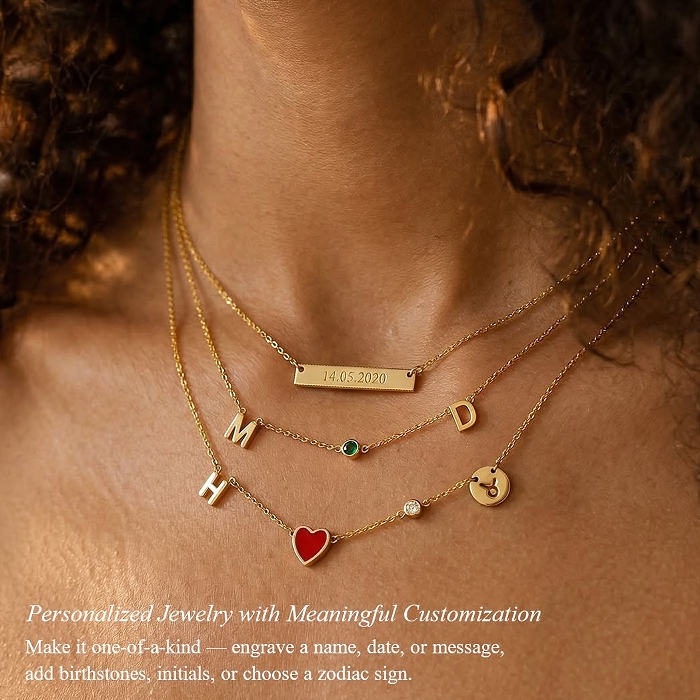
You may not have tried it before, but pendants and charms can look beautiful layered together. A pendant can take the lead while a few charms add something more personal, especially when they sit at different lengths.
A formula that tends to work:
- Shorter chain, charms. A 16-inch chain at the collarbone carrying two or three small charms — an initial, a birthstone, a tiny heart.
- Longer chain, pendant. An 18–20 inch chain underneath, with the statement pendant anchoring the look.
- Leave at least 2 inches between chain lengths. That gap is generally what keeps the layers from crossing and tangling into the drawer-of-knotted-chains situation most of us know too well.
Two smaller notes that tend to matter more than they sound like they would. First, match the chain weight to the piece — a heavier pendant usually wants a chain that can carry it (a common guideline is at least 1.2mm thickness for stones over 2 carats), while charms often look best on whisper-thin chains. Second, restraint helps: beyond three pieces on one chain, individual charms tend to stop reading as individual objects.
Want the full chain-length breakdown? Our pendant vs necklace guide covers 14 to 34 inches in detail.
Stones and Metals: What to Look For
Because charms are small, they’re usually solid metal or enamel — there’s not much room for serious stones, and most charm designs lean on shape and symbolism instead. Pendants are where gemstones tend to get interesting.
A few things worth knowing before you shop:
- Lab-grown diamonds are real diamonds — same chemistry, same hardness, same light performance, grown in a laboratory rather than mined. They’re graded on the same 4C scale used for mined stones, and they often cost substantially less.
- Moissanite brings serious sparkle at a lower price. Its refractive index runs 2.65–2.69 against diamond’s 2.42, For a pendant built to turn heads, moissanite is often the value pick.
- Recycled gold is a quiet upgrade. Once refined, recycled 14K gold is the same metal as newly mined 14K gold — same karat, same durability — without newly disturbed ground. For a piece you plan to wear for decades, it’s an easy box to check.
Browse our pendants & charms collection and the full necklace selection to see these materials in finished pieces — or dig into the zodiac necklace guide for meaning-driven pendant ideas.