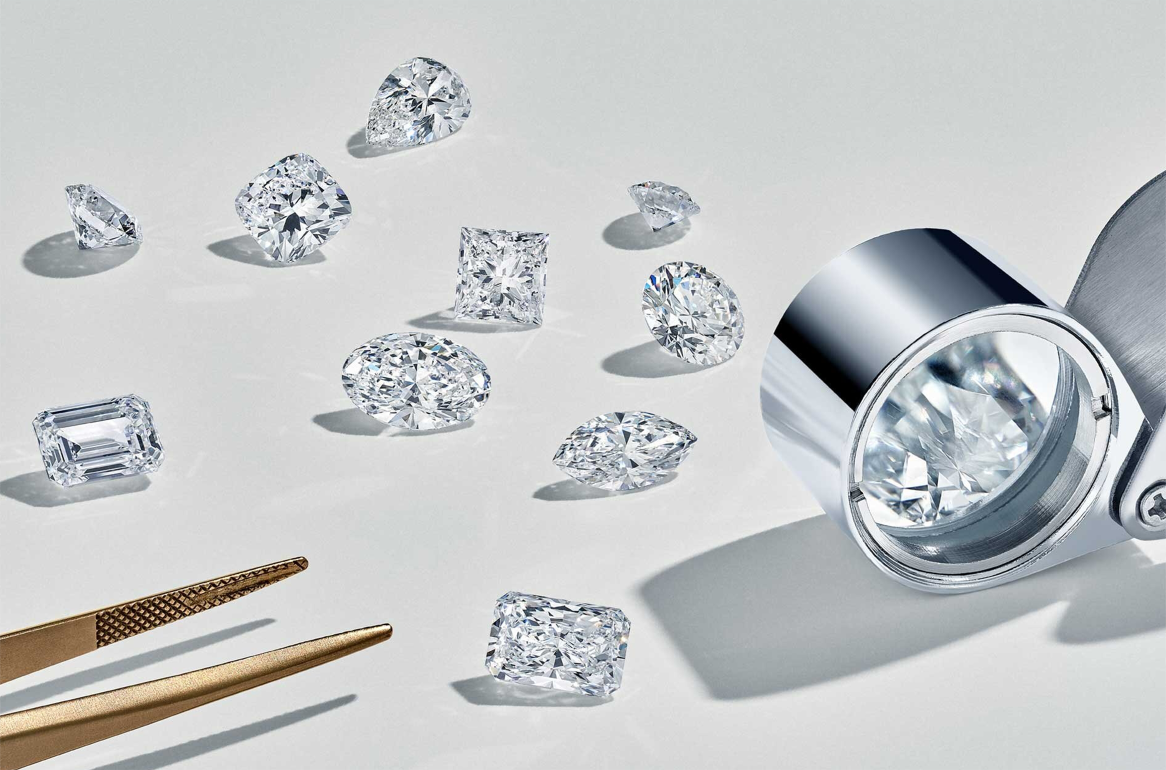
Why can two diamonds look identical on paper, with the same carat weight and shape, yet cost a few hundred dollars more or less? That’s where an IGI report comes in. Here’s what an IGI-certified diamond actually means, what the report can tell you, what it can’t, and how to use it before you buy.
What IGI Actually Is
IGI stands for the International Gemological Institute, founded in Antwerp, Belgium, in 1975. Today, IGI operates laboratories across major diamond hubs, including Antwerp, New York, Mumbai, Dubai, Bangkok, Tokyo, and Los Angeles. It examines and grades diamonds, colored gemstones, and finished jewelry. The reports it issues, known as IGI reports, provide an objective and independent record of a stone’s characteristics, helping you understand what you’re actually buying.
What “IGI Certified” Actually Means
When a diamond has an IGI grading report, the stone has been submitted to the lab, examined, and graded. The report ties those results to that specific diamond through a unique report number. Many IGI-graded diamonds also carry a laser inscription on the girdle, the thin edge around the widest part of the stone.
What an IGI Report Documents
The report documents several important details:
- Identity: whether the stone is a natural diamond or a laboratory-grown diamond. IGI can also identify other materials when they are submitted for examination.
- The 4Cs: cut, color, clarity, and carat weight. Color follows the D-to-Z scale, while clarity ranges from Flawless to Included. IGI also assigns a cut grade to round brilliant diamonds.
- Finish details: polish, symmetry, and fluorescence.
- Lab-grown details: for laboratory-grown diamonds, the report can identify the growth method, such as CVD or HPHT, along with applicable treatments or comments.
What “IGI Certified” Does Not Mean
It’s not an appraisal. An IGI grading report does not assign a dollar value to the diamond. Instead, it documents the stone’s characteristics and quality grades. If you need a value for insurance purposes, you need a separate appraisal.
It’s not a quality award. A diamond with heavily included clarity can still receive an IGI report. The report documents what the stone is and how it grades. It does not tell you whether the diamond is a good buy. You still need to compare the grades, proportions, appearance, and price.
It’s not a guarantee of value. An IGI report makes diamond shopping easier because it gives you standardized information to compare. However, the report itself does not tell you whether the asking price is fair.
So, think of the report as a passport, not a trophy. It documents the diamond’s identity and characteristics. The grades inside help you decide whether the stone is right for you.
How to Read an IGI Report
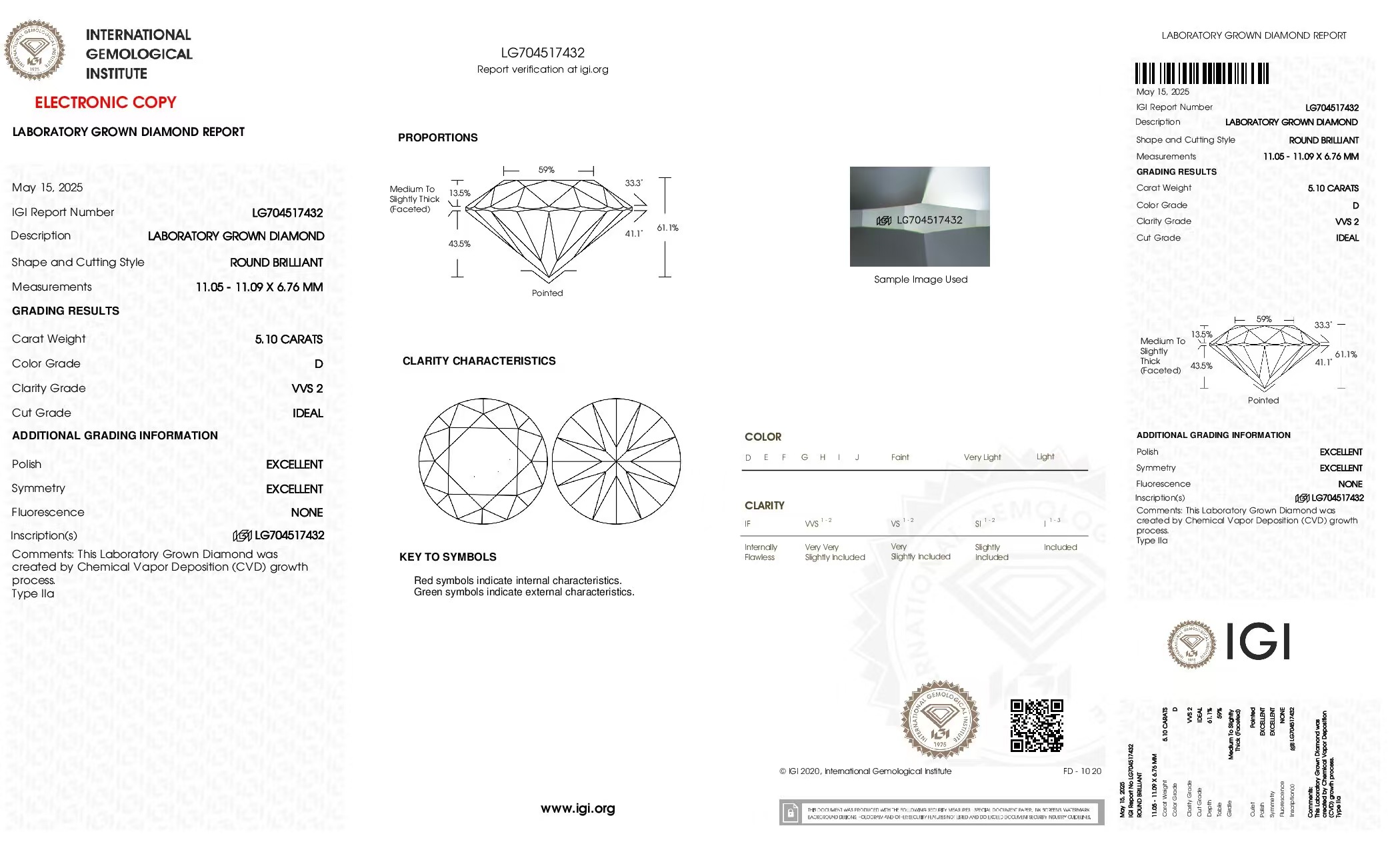
An IGI report for a lab-grown diamond reads much like a spec sheet. Here’s what each section tells you.
What Each Section Means
- Report number and date: the reference point for the report. Use the report number when you verify the document online.
- Shape, cutting style, and measurements: the diamond’s physical dimensions in millimeters. These details help you compare the report with the actual stone and understand its size and proportions.
- Carat weight: the diamond’s measured weight in carats.
- Color grade (D–Z): D represents the highest color grade in the D-to-Z scale. As you move down the scale, more body color becomes visible.
- Clarity grade : the diamond’s internal inclusions and surface blemishes, graded on a clarity scale from Internally Flawless to Included. Some reports also include a clarity plot showing where specific characteristics appear.
- Cut grade, polish, and symmetry: details that help you assess the diamond’s cut and finish. For round brilliant diamonds, the cut grade provides an important starting point. Excellent grades can be desirable, but they aren’t the only factors that affect appearance.
- Fluorescence: how the diamond reacts to long-wave UV light. This report lists fluorescence as None. Fluorescence isn’t automatically good or bad, so consider it alongside the diamond’s color and overall appearance.
- Comments: a section worth reading. For laboratory-grown diamonds, the report can identify the growth method, such as CVD or HPHT, along with other relevant information. In this example, the report identifies the diamond as CVD-grown and Type IIa. “Laboratory Grown” also appears on the report.
How to Verify an IGI Report
This is the part that protects you from relying on a piece of paper alone. IGI’s online verification tool lets you check whether the report number and details match the lab’s records.
- Find the report number on the document.
- Go to IGI’s official website and use its report verification tool. Type the address yourself rather than relying on an unfamiliar link from a seller.
- Enter the report number and review the online record.
- Compare the details with the document in front of you. Check the carat weight, measurements, grades, comments, and other key information.
If something doesn’t match, stop and ask the seller about it before you pay.
What an IGI Report Can’t Tell You
An IGI report gives you standardized information about a diamond, but it can’t tell you everything you need to know before buying.
It doesn’t show exactly how lively the diamond looks in person. It also can’t tell you whether inclusions are visible to the naked eye, how the stone performs in different lighting, or whether you personally like its appearance.
The report also doesn’t determine whether the asking price is fair. Two diamonds with similar grades can look different and sell for different prices.
That’s why an IGI report should be your starting point, not your final decision. Use the report to narrow your choices, then compare the diamond’s actual appearance, measurements, photos or videos, and price.
IGI vs GIA: What’s the Difference?
When you’re shopping for a gemstone or a gemstone ring, you may also come across GIA, alongside IGI. So, what’s the difference between the two? Let’s take a look.
GIA, the Gemological Institute of America, developed the 4Cs system and built its reputation primarily around natural diamonds. It is a nonprofit organization and remains one of the best-known names in natural diamond grading. IGI is an independent commercial gemological laboratory with a particularly strong presence in laboratory-grown diamond grading.
The comparison changed in October 2025. GIA introduced a new Laboratory-Grown Diamond Quality Assessment for eligible loose, colorless to near-colorless lab-grown diamonds. Instead of using the traditional color and clarity nomenclature, GIA now classifies qualifying stones as Premium or Standard. Stones that do not meet the minimum criteria do not receive a GIA Quality Assessment.
IGI continues to provide detailed lab-grown diamond reports with specific 4Cs grades. Its reports document color, clarity, cut, carat weight, measurements, and other relevant characteristics.
So, if you’re comparing two lab-grown diamonds side by side, an IGI report can give you more specific grading information to work with.
| IGI | GIA | |
|---|---|---|
| Founded | 1975, Antwerp | 1931, California |
| Structure | Independent commercial laboratory | Nonprofit organization |
| Strong presence | Lab-grown diamond grading | Natural diamond grading |
| Lab-grown report style | Detailed 4Cs grades | Premium / Standard Quality Assessment for eligible stones since October 2025 |
| Best known for | Detailed lab-grown diamond reports | Natural diamond grading and gemological research |
| Best for | Comparing specific lab-grown diamond grades | Natural diamonds and GIA’s quality assessment system |
IGI Diamond Buying Checklist
Before buying a lab-grown diamond with an IGI report, run through these checks:
- Verify the report number. Make sure the report appears in IGI’s online verification system.
- Confirm the diamond’s identity. Check that the report identifies the stone as laboratory-grown if that is what you’re buying.
- Check the 4Cs. Review carat weight, color, clarity, and cut where a cut grade applies.
- Review the measurements. Compare the dimensions with the listing and the actual diamond.
- Read the comments. Look for the growth method and any disclosed treatments or other relevant information.
- Check clarity beyond the grade. If possible, look at photos or videos and confirm that the diamond appears eye-clean.
- Consider fluorescence. Don’t automatically reject or prefer fluorescence. Judge it alongside color and the diamond’s actual appearance.
- Compare similar stones. Look at diamonds with similar specifications before deciding whether the price makes sense.
- Check the return policy. A clear return window gives you another layer of protection if the diamond doesn’t look as expected.
- Match the report to the stone. If there is a laser inscription on the girdle, check that the number corresponds with the report.
The report gives you the information. Your job is to use it to make the comparison.
Why an IGI Report Matters When Buying a Diamond
An IGI report isn’t just paperwork to file away. It gives you a consistent way to compare diamonds before you buy.
Carat and price are the two numbers many listings lead with, but neither tells you whether a stone is bright and well-proportioned or dull at the same weight. Read the report carefully, then look beyond the grades at the diamond’s actual appearance, measurements, and price.
At She Said Yes, our lab-grown diamonds come with IGI reports that you can verify yourself. That means you don’t have to simply take our word for what you’re buying. You can check the details yourself. Our jewelry pair lab-grown diamonds with recycled gold settings, and you can customize your ring to make it your own. Our collection includes rings, necklaces, earrings, and more, so you can find a piece that feels personal to you.
Frequently Asked Questions
What does IGI certified mean?
“IGI certified” is commonly used to describe a diamond that has been examined and graded by the International Gemological Institute. The resulting IGI report documents the diamond’s identity, 4Cs grades, measurements, and other characteristics.
Is an IGI report trustworthy?
IGI is one of the most widely recognized gemological laboratories in the world and is widely used for grading laboratory-grown diamonds.
What is the difference between IGI and GIA?
Both are established gemological organizations, but they have different strengths. GIA is particularly well known for natural diamond grading, while IGI has a strong presence in laboratory-grown diamond grading.
Do lab-grown diamonds need a grading report?
No. A lab-grown diamond does not legally need an IGI or GIA report to be sold. However, a grading report is useful when you want to verify the diamond’s identity and compare its quality with other stones.
What should I look for on an IGI report?
Start with the cut grade for round brilliant diamonds, then review color and clarity. Also check the carat weight, measurements, fluorescence, comments, and any disclosed treatments.
How can I verify an IGI report?
Enter the report number into IGI’s official online verification tool and compare the online record with your document. Check the carat weight, measurements, grades, comments, and other key details. If the diamond has a laser inscription, you can also compare that number with the report.