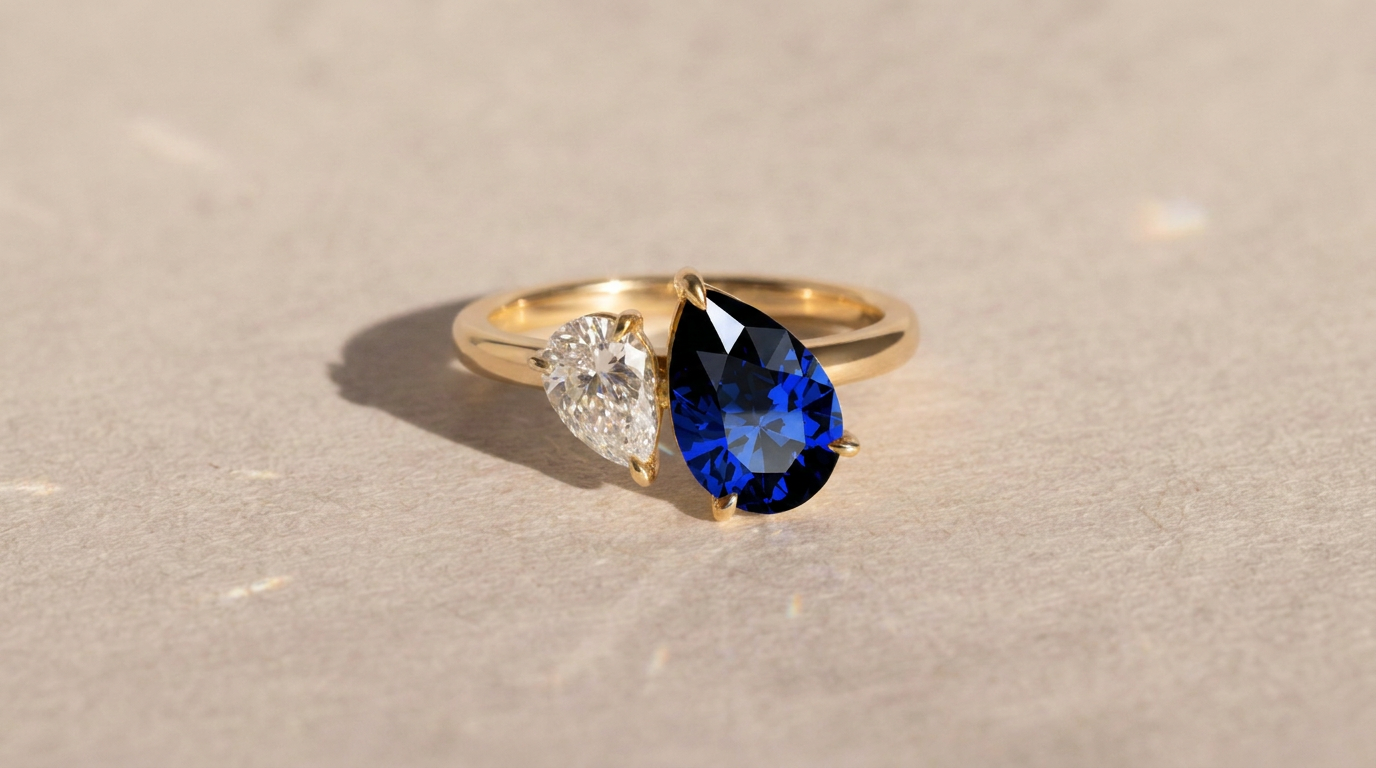
In 1796, a 26-year-old general named Napoleon Bonaparte proposed to Joséphine de Beauharnais with a ring that would look radical even by today’s standards: two stones, a diamond and a sapphire, set side by side on a simple gold band. No halo. No pavé. Just two gems leaning into each other.
That ring sold at auction near Paris in 2013 for just under a million dollars — not because of the size of its stones, but because of what they stood for.
That’s the whole point of a toi et moi ring. The design does the talking. And after two centuries of quiet elegance, it’s back on the hands of some of the most-watched women in the world.
Here’s everything you need to know before you buy one — what the style means, where it came from, which stones work best together, and how to choose a ring that tells your two-person story.
What Is a Toi et Moi Ring?
A toi et moi ring holds two stones side by side on one band. The name is French for “you and me,” and the design couldn’t be more literal: two gems, two people, one shared life.
Unlike a solitaire, which spotlights a single center stone, a toi et moi gives both stones equal billing. Neither one is “the main event.” They can match exactly, or they can be completely different — a diamond next to a sapphire, a pearl next to a moissanite, a ruby next to an emerald.
The style works for any kind of ring — engagement, anniversary, promise, or a piece you simply fall in love with. But it carries particular weight as an engagement ring, because the symbolism is impossible to miss.
What a Toi et Moi Ring Means
At its core, the toi et moi meaning is partnership. Two distinct people choosing one shared path.
But the reason the style has survived for over two centuries is that it leaves room for your own interpretation:
- Two souls, one band — the classic reading, and the reason it endures as an engagement style
- Opposites that complete each other — different stones, different colors, different personalities, one setting
- Equality — neither stone outranks the other; some couples read this as the quiet point of the whole design
- A story only you two know — birthstones, a gem from a family piece, a stone that marks where you met
Toi et Moi vs Solitaire: Which Should You Choose?
If you’re torn between a two-stone ring and a classic single-stone design, ask yourself one question: do you want a spotlight, or a conversation?
A solitaire is about maximum impact from one stone. It’s timeless, it photographs beautifully, and nobody will ever ask you to explain it. If you want the biggest possible look for your budget and a design that never goes out of style, a solitaire is a safe and honest choice.
A toi et moi is about the relationship between two things. It’s more distinctive — you will rarely see another one on someone else’s hand. It invites questions. And it gives you a second stone’s worth of room to embed meaning, color, or personal history.
There’s also a budget angle that surprises people. Two smaller stones almost always cost less than one big stone of the same total weight. Diamond prices climb steeply as individual carat weight goes up, so two 1-carat diamonds typically cost far less than a single 2-carat diamond. A toi et moi can give you a wider, more substantial look on the finger for noticeably less money.
Choose a toi et moi if you love symbolism, you want a ring people will ask about, you’re drawn to color or mixed stones, or you simply don’t want what everyone else has.
Choose a solitaire if you want one stone to carry the whole design, you prefer a quieter look, or maximum sparkle-per-dollar in a single gem is the goal.
How to Choose a Toi et Moi Ring
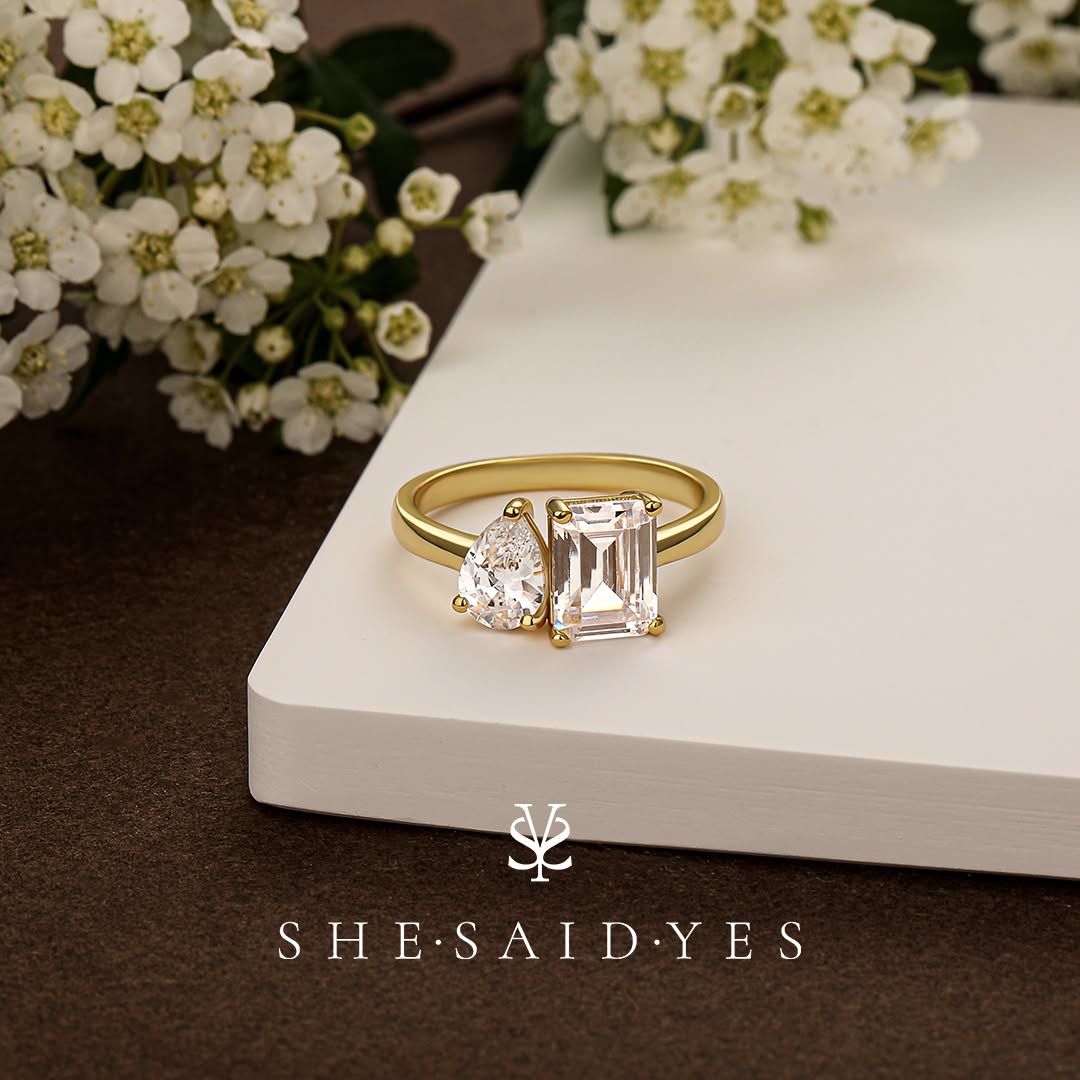
This is where the fun starts — and where most couples make one of two mistakes: picking stones that clash, or picking two identical stones out of fear of clashing. Here’s how to get it right.
Step 1: Choose Your Stone Pairing
The pairing is the soul of the ring. Some combinations have earned their popularity:
- Diamond + sapphire — the original, straight from Napoleon. Cool, royal, and nearly indestructible (sapphire sits at 9 on the Mohs scale). Deep blue against white is a contrast that never argues.
- Diamond + emerald — JFK and Jackie, Megan Fox. Lush and vivid, but be aware: emerald is softer and more brittle than sapphire, so it asks for slightly gentler daily wear.
- Diamond + pearl — Ariana’s approach. Romantic and unusual. Pearls are organic and soft, so this pairing is gorgeous but best for someone who treats jewelry with care.
- Diamond + moissanite — the subtle luxury play. A moissanite’s refractive index actually runs higher than a diamond’s (2.65–2.69 vs 2.42), so the two stones read as siblings while the budget goes further. To most eyes, it simply looks like twice the sparkle.
- Colored pairings — ruby + diamond, aquamarine + morganite, garnet + amethyst. If a color is yours, this is where a toi et moi beats every other style.
A practical rule: pair stones that are at least somewhat close in hardness, or accept that the softer stone will need more care. A diamond-and-sapphire ring can take a decade of daily wear. A diamond-and-pearl ring wants a gentler owner.
Step 2: Choose Your Stone Shapes
You have two directions, and both work:
Matched shapes — pear next to pear, oval next to oval. Clean, balanced, architectural. This is the choice if you love order and want the stones to read as one unit.
Contrasting shapes — pear next to oval, round next to marquise. More movement, more personality, and honestly more forgiving: two slightly different stones hide small imperfections better than a matched pair, which has to match perfectly.
If you’re unsure, look at pear + oval. The silhouettes echo each other without duplicating, and the combo flatters almost every finger.
Step 3: Choose Your Metal
The band is the quiet third character in this story.
Yellow gold warms up colorless stones and flatters olive and darker skin tones. White gold and platinum give diamonds and blue stones a cooler, airier stage. Rose gold does beautiful things for morganite, garnet, and pearls.
And if sustainability is part of why lab-grown and alternative stones appeal to you, ask about recycled gold. A band made from 100% recycled gold carries the same look and the same lifetime of wear, minus the mining.
Step 4: Choose Your Setting Style
Same two stones, four very different rings:
- Side by side — the classic Napoleon arrangement: both stones facing the same direction, shoulder to shoulder. Timeless.
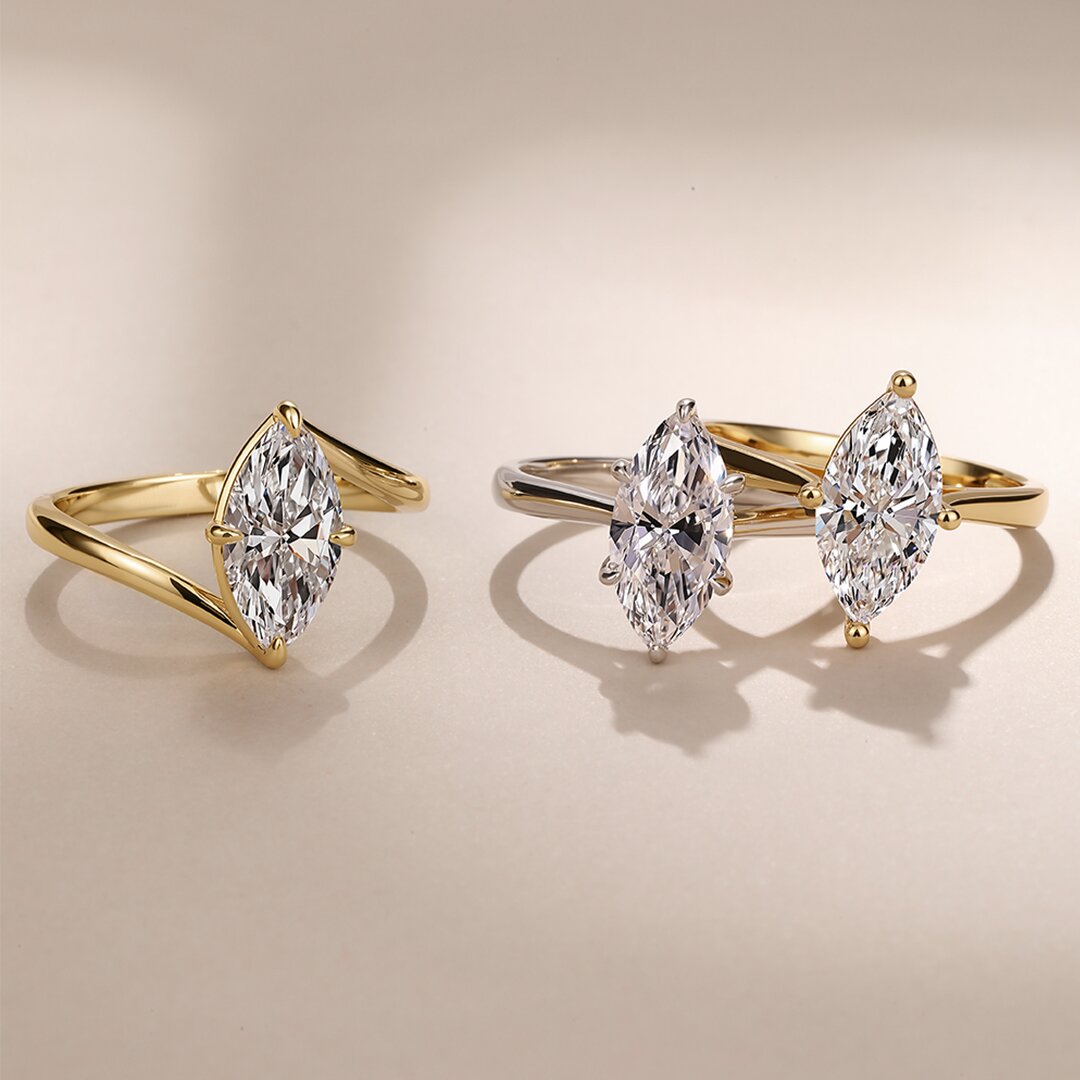
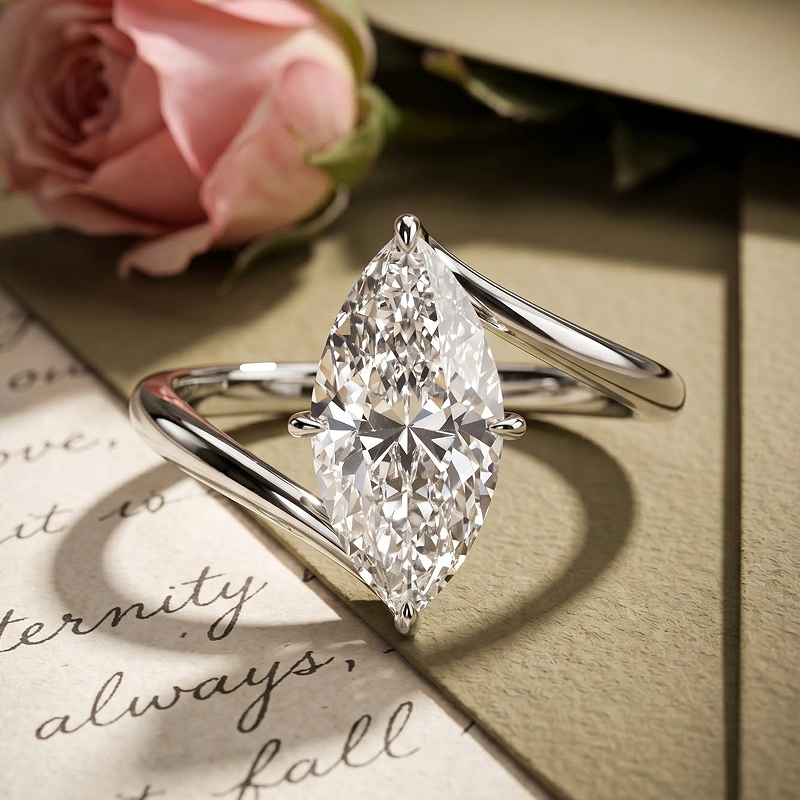
- Twisted band — the band splits and wraps around each stone. The intertwining reads as two lives woven together, and it’s probably the most romantic silhouette in the category.
- Offset heights — one stone sits slightly higher than the other. Subtle, modern, and great for pairings of different sizes.
- East-west — stones set horizontally across the finger instead of pointing along it. Rare, editorial, and a genuinely fresh look in 2026.
Whichever you choose, run your finger over the setting before you commit. Two stones means more metalwork at the top of the ring — prongs should feel smooth, nothing should snag, and the ring should sit level on your hand.
Step 5: Make It Yours (Consider Custom)
One of the things that makes a toi et moi ring so personal is how naturally it lends itself to customization. With two stones at the center, you can give each one its own meaning. One stone for you and one for your partner. Two birthstones that represent your birth months. A gemstone chosen to honor a family member. Or simply two colors you love together.
The possibilities go beyond matching stones, too. You can mix different shapes, sizes, or even gemstones to create a combination that feels entirely your own. If you want an engagement ring that feels personal rather than familiar, a toi et moi design gives you plenty of room to tell your story.
How Much Does a Toi et Moi Ring Cost?
There is no single answer, because the two-stone format stretches across every budget. But the honest ranges:
Two diamonds sit at the top, and total carat weight drives the price. Remember the multiplier effect in reverse: two stones of 1 carat each will cost dramatically less than one stone of 2 carats, even though the spread across your finger looks bigger.
Diamond + colored gemstone often brings the price down while adding color — sapphires and emeralds in smaller sizes are far more affordable than equivalent diamonds.
Lab-grown diamond + moissanite pairings are the value play of the decade. A lab-grown diamond is chemically and optically a diamond — and it comes with certification from independent labs like IGI, so you know exactly what you’re buying. Pair it with a moissanite and you get a two-stone look with serious brilliance for a fraction of the mined-diamond route.
One budget warning: don’t save money on the band. A toi et moi carries two stones’ worth of weight and leverage at the top of the ring — a sturdy, well-made setting is what keeps both stones safe for decades.
How to Wear a Toi et Moi Ring
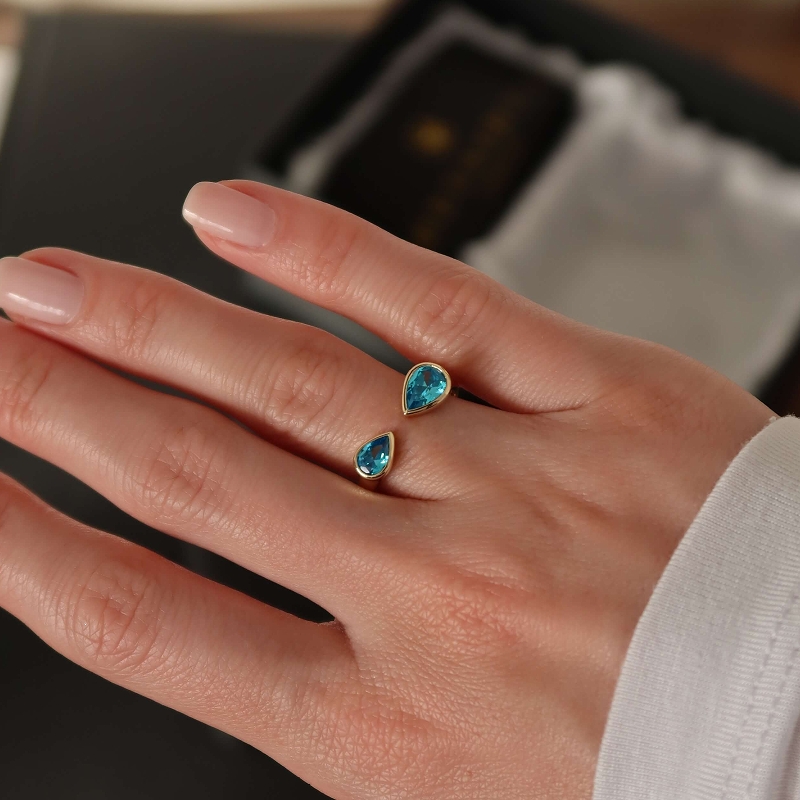
Which finger? The same basic considerations apply as with any engagement or statement ring. In the U.S., an engagement ring is traditionally worn on the left ring finger, while a toi et moi worn as a fashion or statement ring can go on whichever finger feels right. There’s no hidden protocol.
Which direction? This is the question nobody agrees on, which means you get to decide. Some wearers point both stones outward, toward the world. Some angle the “you” stone toward themselves and the “me” stone outward — a small private gesture nobody else will ever notice. Try the ring on both ways. One of them will feel like yours immediately.
Stacking: a toi et moi pairs beautifully with a slim wedding band. Two approaches work: a contoured band that nestles around the stones, or a straight band worn on the opposite side of the stack. Give the top of the ring a little breathing room — two stones take up more finger real estate than one.
FAQ
What does “toi et moi” mean?
It’s French for “you and me.” The name describes the design: two stones set side by side on one band, symbolizing two people in one relationship.
Can a toi et moi ring be an engagement ring?
Absolutely. It’s one of the fastest-growing engagement ring styles right now — Ariana Grande, Megan Fox, and Emily Ratajkowski all wore two-stone rings.
Which stone should face outward on a toi et moi ring?
There’s no rule — try both. Many wearers keep the stone that represents their partner angled toward themselves and their own stone facing out.
Are toi et moi rings more expensive than solitaires?
Usually the opposite. Because diamond prices rise steeply with a single stone’s carat weight, two smaller stones almost always cost less than one large stone of equal total weight — while spreading more sparkle across the finger.
Can I design a custom toi et moi ring with different stones?
Yes — and it’s where the style shines. Because the format is built around two stones, it naturally accommodates birthstone pairs, family stones, or contrasting gems. Most custom jewelers will sketch the design, refine it with you, and produce a 3D model before casting.
The Two-Stone Verdict
A toi et moi ring isn’t trying to be the biggest, the brightest, or the most conventional ring in the room. It’s trying to say one true thing: that two different people chose one life.
That’s why Napoleon’s simple diamond-and-sapphire band outlived an empire. That’s why, two centuries later, the most-watched engagements on the planet keep reaching for two stones instead of one. The style endures because the sentiment does.
If you go this route, make it yours. Choose stones that mean something — a birthstone, a family pearl, a moissanite whose fire outsparkles a diamond at a fraction of the cost. And when someone asks about your ring, you’ll have a story, not a spec sheet.