You’ve probably heard the term eternity ring, but what exactly is it? At first glance, it may look like a simple diamond band, but its design tells a much deeper story. Let’s take a closer look at what makes an eternity ring so special.
What Is an Eternity Ring?
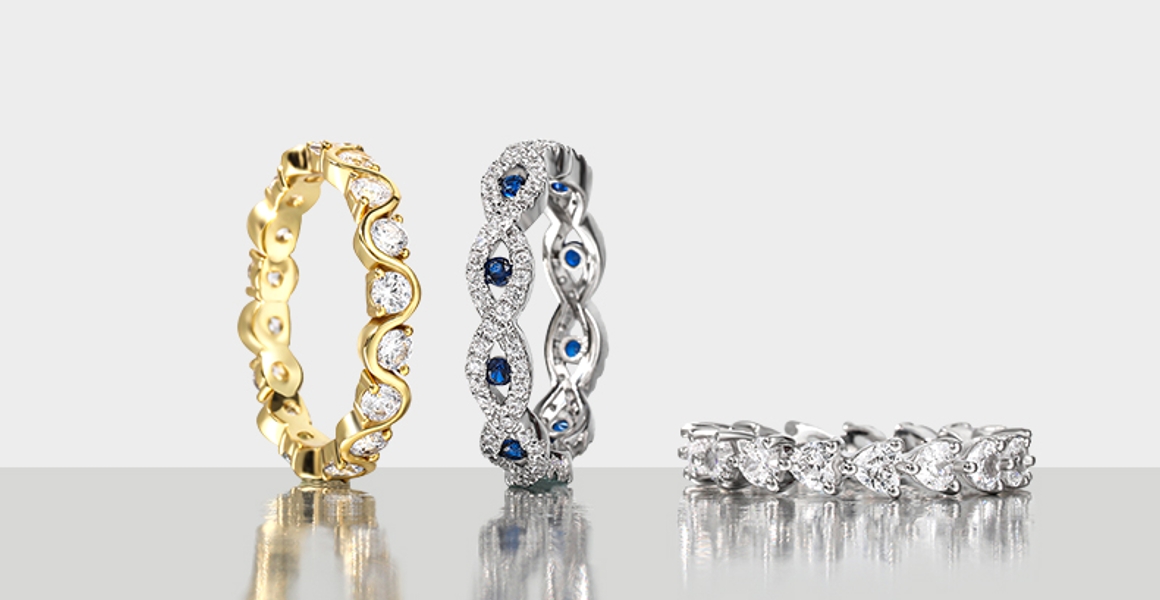
An eternity ring is a metal band set with a single, continuous row of gemstones running all the way around it. Most feature diamonds, but sapphires, rubies, emeralds, moissanite, and birthstones are all common choices. The defining feature isn’t the stone — it’s the circle.
Because the gems run uninterrupted, the band reads as a symbol of something that doesn’t break. The meaning is baked into the shape itself.
A circle has no beginning and no end, which is why eternity rings have carried the same association — lasting commitment — since the Ancient Egyptians first used circular bands as tokens of forever roughly 4,000 years ago.
So who is it for? Anyone marking an ongoing commitment — an anniversary, a new baby, a vow renewal, or a milestone that deserves a permanent placeholder on the hand.
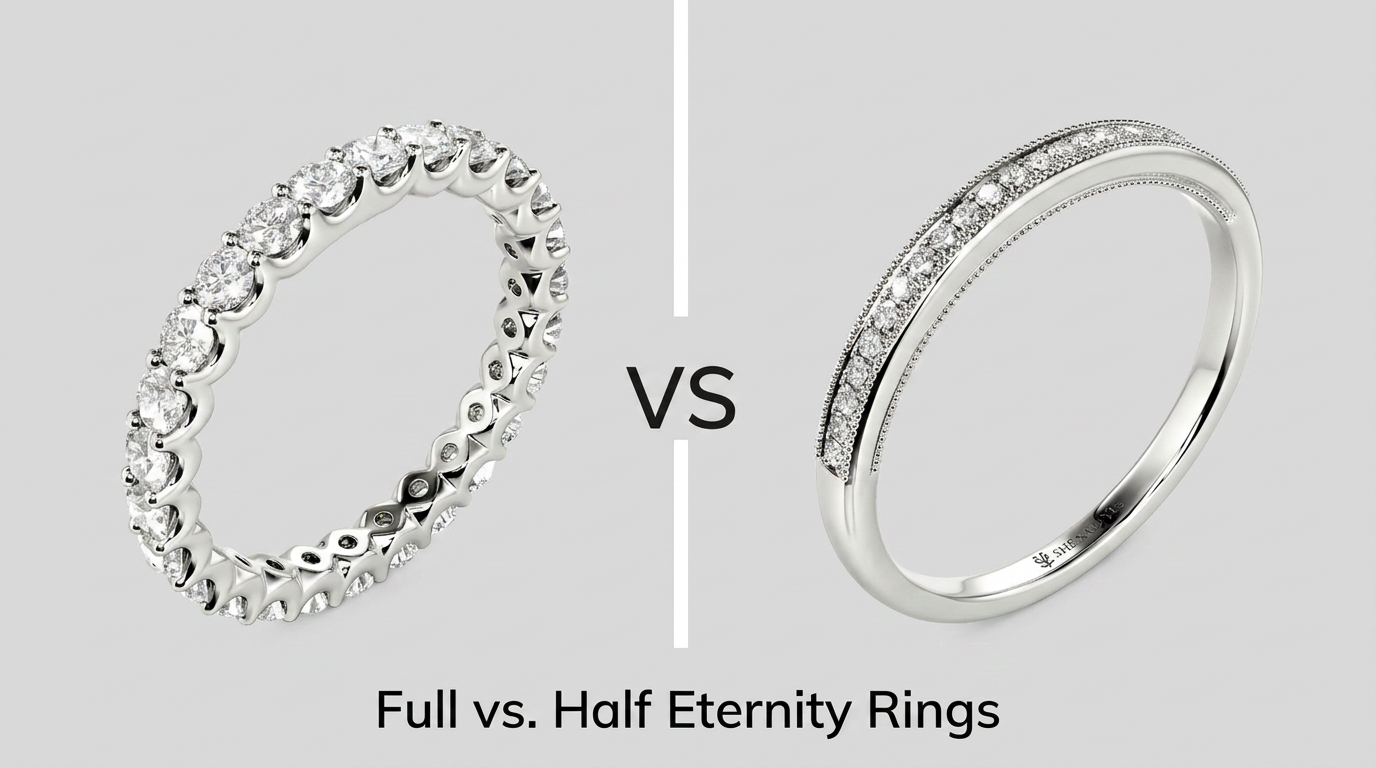
Full vs. Half Eternity Rings
The first real choice isn’t stone or metal — it’s full versus half. This single decision affects comfort, price, resizing, and how the ring wears five years from now, so it’s worth understanding before anything else.
| Full Eternity | Half Eternity | |
| Stones | Run around the entire band | Set across the top half only |
| Sparkle | Visible from every angle | Stones face up; plain metal underneath |
| Comfort | Gems under the finger can feel pronounced | Smooth metal at the back — usually comfier |
| Resizing | Cannot be resized | Can normally be resized |
| Price | Higher (more stones) | Lower (fewer stones) |
If the ring will be worn every day and you’re unsure of the exact size, a half eternity usually makes life easier — it’s resizable and the smooth underside tends to suit most hands. We see most of our everyday customers land here for exactly those reasons.
A full eternity is the stronger symbol and sparkles from every angle, which is hard to fake. But because it can’t be resized, get a confirmed size before ordering. Surprising someone with a full band in the wrong size is a sweet gesture that turns into a logistical headache.
Choosing Your Stones
When it comes to choosing a gemstone, do you still think diamonds are the only classic choice? The truth is, your gemstone selection influences your ring’s price, sparkle, and ethical impact more than any other single decision.
Mined Diamond
A mined diamond eternity ring is the traditional choice, graded on the same 4C scale — cut, color, clarity, carat — established by the GIA. Round brilliants stay the most popular shape because they return the most light, while princess and baguette cuts line up cleanly for an almost uninterrupted band of brilliance.
Lab-Grown Diamond
A lab-grown diamond is optically and chemically the same stone — same hardness, same brilliance — graded to the same IGI standards. The difference is origin and cost: lab-grown typically runs meaningfully lower in price, and produces about 0.025 kg of CO₂ per carat versus roughly 125 kg for a mined stone.
Moissanite
Moissanite is the wildcard more people should consider. It ranks 9.25 on the Mohs scale (diamond is 10) and actually throws more fire — its refractive index of 2.65–2.69 sits above diamond’s 2.42 — so a moissanite eternity ring can read as the most sparkly option on the hand, at a fraction of the price.
Colored Gemstones
Sapphire, ruby, and emerald carry their own meanings — loyalty, passion, growth — and a birthstone turns the band into something only the wearer fully understands. They tend to cost less than an all-diamond band while adding personal weight.
The shortcut: if budget is the constraint, lab-grown diamond and moissanite let you cover a full eternity band for less than a half band of mined stones — and most people can’t tell them apart without specialist equipment.
Metal and Setting
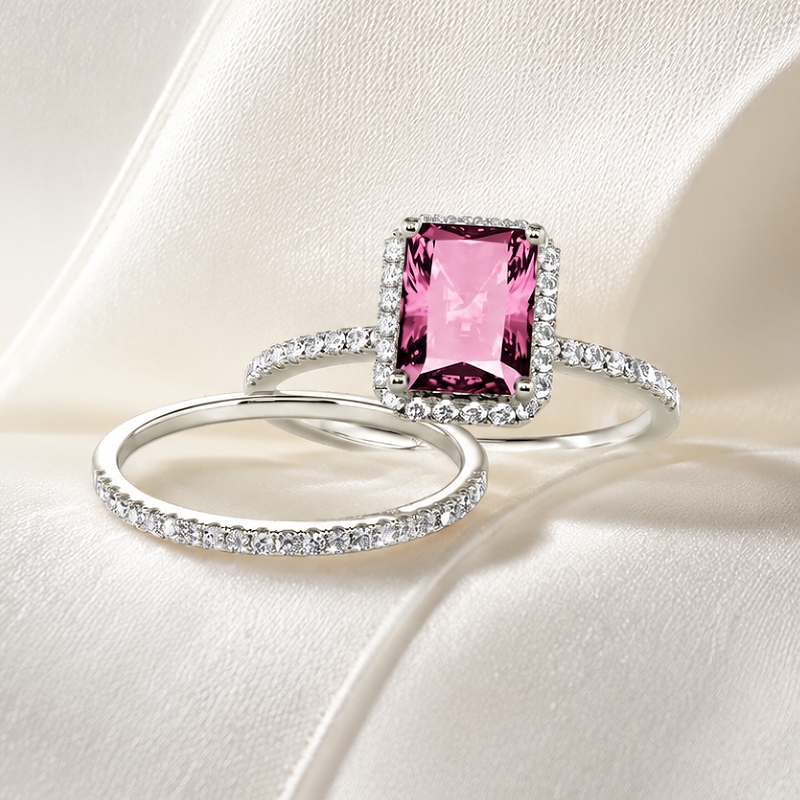
The simplest rule that holds up over time: match the metal of the engagement ring and wedding band. Metals of different hardnesses worn side by side can wear unevenly over the years, so a platinum eternity next to a platinum wedding ring ages better than mixing platinum with softer gold.
On color, warm skin tones tend to flatter yellow and rose gold; cooler tones often read cleaner against white gold or platinum. But the metal-matching rule comes first — a comfortable stack beats a color theory win.
Setting drives both look and practicality. Prong settings let in the most light for maximum sparkle, but the prongs can catch on knits and sweaters. Channel and bezel settings sit flush and tend to snag less, which matters if the wearer works with their hands. Pavé packs many small stones together for a soft, textured shimmer.
When to Give an Eternity Ring
The most common moments are a wedding anniversary — the first or the tenth is popular — the birth of a child, a vow renewal, or a milestone the two of you simply want to mark.
Increasingly, people buy eternity rings for themselves to celebrate something personal: a promotion, a milestone birthday, a fresh start. The symbolism still holds — a circle of stones marking a chapter you don’t want to forget.
If you’re waiting for the “right” occasion, the honest answer is that any moment worth remembering is the right one.
How to Wear It: Order, Finger, and Stacking
Tradition places the eternity ring on the ring finger of the left hand, stacked on the outside: wedding band closest to the heart, then the engagement ring, then the eternity ring on top.
In practice, plenty of people move the order around — or wear the eternity alone on the right hand so it doesn’t compete with the engagement ring for attention. If all three rings will sit together, matching the metal helps them wear evenly.
There’s no wrong answer here. If three rings on one finger feels heavy or busy, wearing the eternity separately on the other hand is a clean solution.
How to Choose: a Quick Decision Framework
Start with the wearer’s day, not the catalog. If she works with her hands or is rarely without her rings, lean toward a half eternity in a channel or bezel setting — it’s comfortable, secure, and resizable.
If the ring is a statement piece for occasions, a full eternity in prong-set lab-grown diamonds or moissanite gives maximum impact for the budget. Then match the metal to her existing rings, confirm her size (essential for a full band), and pick the stone by priority:
- Mined diamond for tradition and resale value
- Lab-grown diamond for value without compromise
- Moissanite for the most sparkle per dollar
- Colored gemstone for personal meaning
Some jewelry is admired for its beauty. Some is treasured for the story it carries. An eternity ring has a way of becoming both. The circle never changes, but the meaning behind it continues to evolve with every anniversary, every celebration, and every ordinary day in between.
If you’re ready to find the perfect eternity ring for yourself or someone you love, explore She Said Yes eternity rings of thoughtfully crafted designs. From full and half eternity bands to classic diamond designs and colorful gemstone styles, each piece is created to celebrate life’s most meaningful moments with timeless beauty.